This is how the AI article summary could look. Lorem ipsum dolor sit amet, consectetur adipiscing elit, sed do eiusmod tempor incididunt ut labore et dolore magna aliqua. Ut enim ad minim veniam, quis nostrud exercitation ullamco laboris nisi ut aliquip ex ea commodo consequat.
This article will describe 20 facts about kidneys.
Let’s now go through 20 top facts about the kidneys.
Your kidneys are vital organs – just like your brain, heart, lungs and liver. Your kidneys clean your blood, help control your blood pressure, help make red blood cells and keep your bones healthy
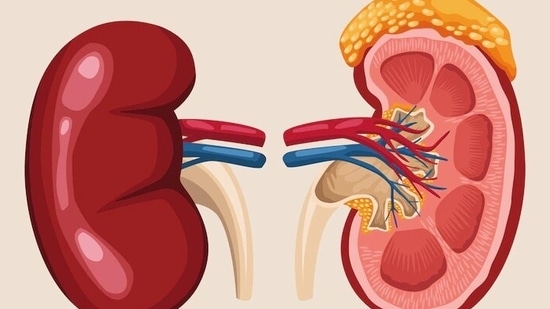
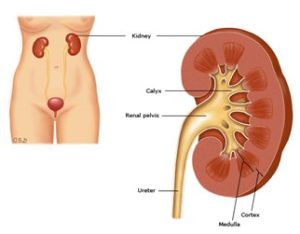
Where are the kidneys and how big are they? The kidneys are two bean-shaped organs located on either side of the spine, just below the rib cage (see diagram below). They are about the size of your palm: 12 (10-14) cm long, 6 cm wide and 3 cm deep, and weigh about 150g. The right kidney is slightly lower (and smaller, no one knows why), as it is pushed down by the liver.
– Even though the kidney only accounts for 0.5% of the body’s weight on average, it receives more blood (20% of the cardiac output) than all other organs except the liver
– Most people are born with two kidneys but 1 in 1000 people are born with one kidney. If you have one (born with one, or other if you have one removed), the kidney grows (hypertrophies), and sustains the body. They will have normal renal function and do not go into CKD unless a disease process happens
Can you feel your kidneys? No. You are not normally able to feel your kidneys. If you can, they are usually pathological (abnormal). They have to enlarge at least 2x to be palpable. In a few slim people, a normal right kidney is palpable on a deep breath in
The kidney has 7 functions – only one is the ‘dustmen role’
What is the main function of the kidney? The kidney’s main role is to filter the blood, and thereby remove waste products and extra water from the body. They are the body’s dustmen. But a kidney is not one big filter, as ..
Each kidney is made up of about a million tiny filtering units called nephrons. The nephron includes a filter, called the glomerulus, and a tubule. Each nephron filters a small amount of blood. The tubule is the drain out of the glomerulus, i.e. how the filtered blood gets out (see diagram below)
– Stretched out from end to end, the nephrons are about 5 miles (8 kilometers) long
How is kidney function measured? This is done using a blood test called Glomerular Filtration Rate (GFR). This is the amount of filtrate formed per minute by the glomeruli in the kidneys. It is a measure of kidney function because it shows us how much the kidneys are filtering and doing their job – the higher the GFR, the better
– Normal human GFR is 90-120 ml/min. If it is 120 ml/min, this is equivalent to 7 litres of blood are filtered (cleaned) an hour, or 180 litres per day [“pretty amazing eh?” Ed]
– This equates to a normal blood creatinine (a waste product in your blood that comes from muscles that we use as a measure of filtration) level of 60-120 micromol/L – the lower the creatinine, the better
– Therefore the kidneys filter (and clean) your blood 36x a day, with a blood volume of 5 litres. Even though 180L are filtered, most of the filtered liquid is put back (reabsorbed) into the blood as only 2L (less than 2% of what is filtered) of urine emerge each day – if you drink 2.5L a day
What is Chronic Kidney Disease (CKD)? It is a long-term condition where the kidneys do not work as well as they should, or are damaged in some other structural way
CKD affects 10% of the population. But fortunately only 1 in 100 of them develop CKD5/ESRF, and need dialysis or a transplant (i.e. 1 in 1000 of the population)
– However most of these are older people, who have a (partly age-related) mild dysfunction (CKD1-3), that does not normally progress to more advanced stages (CKD4-5) and the need for dialysis. In other words, for many of these older people, it is really a risk factor for more serious CKD, part of the ageing process and not a disease
– CKD has 10 common symptoms(due to 10 associated complications), 7 causes, and 5 stages
CKD is a silent killer – usually with no signs or symptoms until the later stages (CKD4-5). And it can lead to serious complications like heart attack, stroke, kidney failure and death
Early detection of CKD saves lives. Even though CKD is not often completely reversible, it is treatable. When caught and treated early, these serious complications can often be prevented
Progression of mild/moderate CKD (CKD1-3) – to more advanced kidney failure (CKD4-5) can often be slowed down or stopped. This can be done, in many patients, by keeping the blood pressure normal/low, and using ‘reno (kidney) protective’ drugs like ACE/ARBs and SGLT2is
“Keeping your blood pressure normal or low – is the most important thing you can do protect your kidneys – ideally 130/80 or below (at home, GPs or hospital)”
Other ways of protecting your kidneys. Being physically active, keeping a healthy weight, consuming a healthy diet, and getting tested for CKD regularly can help protect your kidneys. Even small changes can make a big difference
How common is ESRF? It is rare, fortunately. The incidence (number of new patients) of ESRF in the UK is 108 new patients per million population per year. This equates to over 7500 new ESRF patients a year. Just under 69,500 adults had ESRF (i.e. on dialysis or had a kidney transplants) in 2021. Of these, 39,000 had had a transplant
Gender and CKD/ESRF. For every two women who develop ESRF, three men develop the disease. However, chronic kidney disease is generally more common in women than men
Age and CKD/ESRF. It is strongly influenced by age. For people aged 65-74 years, 25% have CKD; and 50% of people 75 years or over. The average age of starting dialysis is 63 years
The average kidney transplant waiting time in the UK – for an adult deceased donor transplant is about 3 years. But it is varies considerably, from unit to unit (Oxford has the lowest waiting time)
What is Acute Kidney Injury (AKI)? This is different from CKD. AKI is a condition in which the kidneys lose function rapidly (usually over hours or days), potentially leading to kidney failure if left untreated. Up to 1/3 of hospital admissions – medical and surgical – have a degree of AKI, which is usually ‘pre-renal’ (the problem is due to something else, causing reduced blood flow to the kidneys). The cause of pre-renal AKI is usually dehydration and sepsis (severe infection)
What are kidney infections and stones?
– Most urinary tract infections (UTIs) are bladder infections (or cystitis). But if a UTI occurs in the kidney it is called pyelonephritis
– Kidney stones are very common. In fact, about 1 in 10 people will get a kidney stone during their lifetime. They form when there is an accumulation of certain substances in the urine, causing them to crystallise and form solid masses. These masses can get stuck when leaving the kidney and cause a blockage in the ureter, which can be very painful (this is called renal colic). Many are composed of calcium oxalate
What is kidney cancer? Kidney cancer includes cancers of the outer kidney (90%; cortex and medulla), inner kidney (5%; pelvis, drainage system) and the ureter (5%). Most outer kidney cancers are adenocarcinomas (or renal cell carcinomas, RCCs). Most inner kidney and ureter cancers are transitional cell carcinomas (TCCs).
Kidneys and CKD: in 4 Diagrams and One Video
Diagram 1: where are the kidneys?
Diagram 2: urinary tract, which the kidneys are part of
Diagram 3: how the kidney works – filtration (in glomerulus) and reabsorption (tubule)
Diagram 4: how CKD is diagnosed – by GFR and classified into 5 stages
5 Stages of CKD
The diagnosis of CKD is largely based on a classification of its severity, based on GFR (glomerular filtration rate) – the higher the eGFR, the better.
Video: how do the kidneys work?
Summary
We have described 20 facts about the kidneys. We hope you have found it helpful.



 5 Stages of CKD